Assessing the Environmental Impacts of the SSE4 Pipeline Project
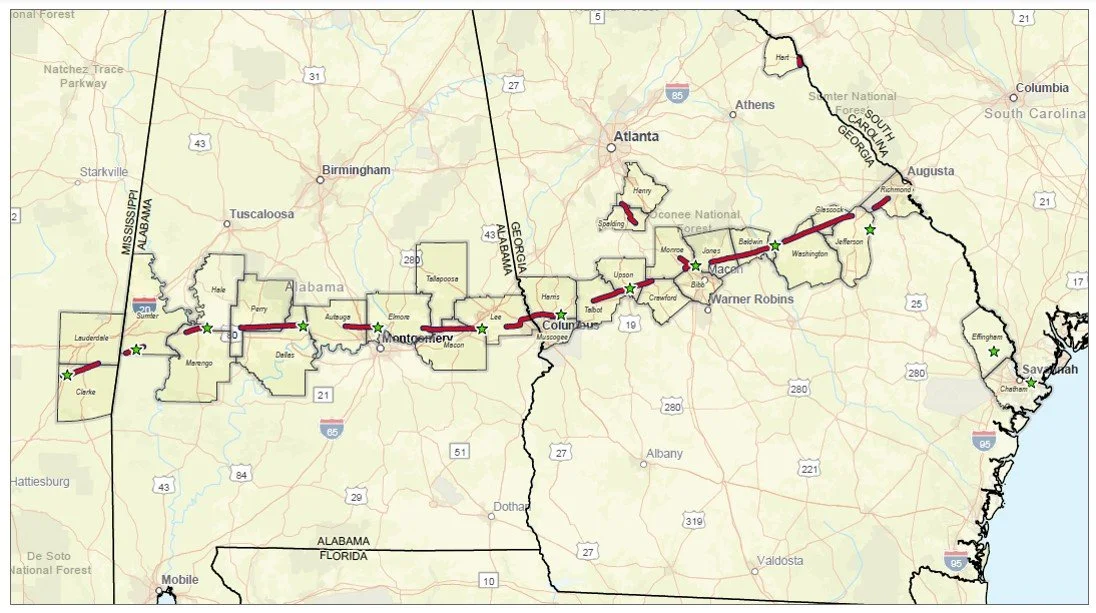
Projected Route of the SSE4 Pipeline. Source: FERC
A new methane gas pipeline is proposed to cross Georgia. The South System Expansion 4 (SSE4) is a proposed natural gas pipeline expansion that would affect parts of Mississippi, Alabama, and Georgia. The project is being developed by Southern Natural Gas (SNG) and Elba Express, subsidiaries of Kinder Morgan, and is currently under review by the Federal Energy Regulatory Commission (FERC).
The proposed project will affect the following counties in Georgia: Harris, Talbot, Upson, Crawford, Monroe, Bibb, Jones, Baldwin, Glascock, Jefferson, Richmond, Burke, Screven, Henry, Spalding, Effingham, Lowndes, Clayton and Chatham.
According to project filings and company materials, SSE4 is designed to increase natural gas transmission capacity across the Southeast to meet projected future demand.
This project follows a recent news that the Georgia Public Service Commission recently approved a massive power grid expansion that will lock-in investments in fossil fuels to meet proported data center demand.
The company says much of the proposed pipeline would remain within the South Main Line’s existing 25-foot right-of-way and run parallel to an existing pipeline dating back to the 1950s. Other sections will require pipeline over new lands.
However, environmental groups have raised concerns about the potential impacts of the pipeline. Alabama Rivers Alliance, Blackbelt Women rising, Energy Alabama, Georgia Interfaith Power and Light, Southern Alliance for Clean Energy, Mary Avery, and the Sierra Club have filed a joint protest calling on FERC to deny the application.
Environmental groups have raised the following concerns:
Overestimate of Need. Opponents argue that the companies have not adequately demonstrated a need for the SSE4 project. The justification for expanding this fossil fuel infrastructure relies heavily on projections of increased energy demand, particularly from proposed data centers. Critics contend these demand estimates may be overstated, calling into question whether the scale of the pipeline expansion is necessary.
Concerns Over Self-Dealing. The protest filing notes that approximately 63% of the pipeline’s subscribed capacity is held by corporate affiliates or partners of the project’s proponents. Southern Natural Gas (SNG) is a joint venture equally owned by Southern Company and Kinder Morgan, with Kinder Morgan also operating the South Main Line. Critics argue this ownership structure raises concerns that the project may be driven more by corporate financial interests than by demonstrated public need.
Danger to Lands and Wildlife. Environmental groups have raised concerns about erosion and sedimentation in affected watersheds, which can damage private land and threaten wildlife habitat. Reporting by the Savannah Morning News highlights the experience of at least one landowner who has already experienced high levels of erosion and timber loss from the existing pipeline, underscoring the potential impacts of additional construction.
Air quality. Pipelines rely on compressor stations to move gas through the system, but these facilities can emit harmful pollutants. The SSE4 project includes 14 compressor stations, only one of which would be electrically powered. Filings raise concerns about emissions of volatile organic compounds (VOCs) and nitrogen dioxide, both of which pose risks to human health, particularly for nearby communities.
Impact on Marginalized Communities. The proposed pipeline route passes through counties in the historic Southern Black Belt and other historically marginalized communities. Protesters note that the company’s own filings acknowledge that 95% of construction workers would be non-local, suggesting that the economic benefits of the project are unlikely to flow to the communities that bear the greatest environmental and health risks.
Safety Concerns. While natural gas pipelines are widely used, they are not without risk. In February 2022, an explosion occurred on the South Main Line. Critics express concern that adding new infrastructure alongside pipelines dating back to the 1950s could increase safety risks if aging systems are not adequately addressed.
Critics argue that the project does not sufficiently evaluate reasonable alternatives. Large infrastructure proposals are typically expected to demonstrate that they serve the public interest and are preferable to other available solutions. In this case, filings make limited reference to alternatives such as battery storage to manage peak demand or increased deployment of renewable energy sources, including solar and wind.
Additionally, observers note that reliance on natural gas exposes consumers to volatility in global fuel markets, which can affect energy prices. This vulnerability was evident during recent international disruptions, including Russia’s invasion of Ukraine, when gas prices spiked and costs were passed on to consumers.
“A pipeline to the past is not the clean energy future faithful Georgians deserve,” said Codi Norred, executive director of Georgia Interfaith Power & Light (GIPL). “Not only does this proposed expansion endanger critical ecosystems and pose serious safety risks to communities along its path, it also locks residents into a costly, polluting system that will affect southern states like Georgia for decades to come.”