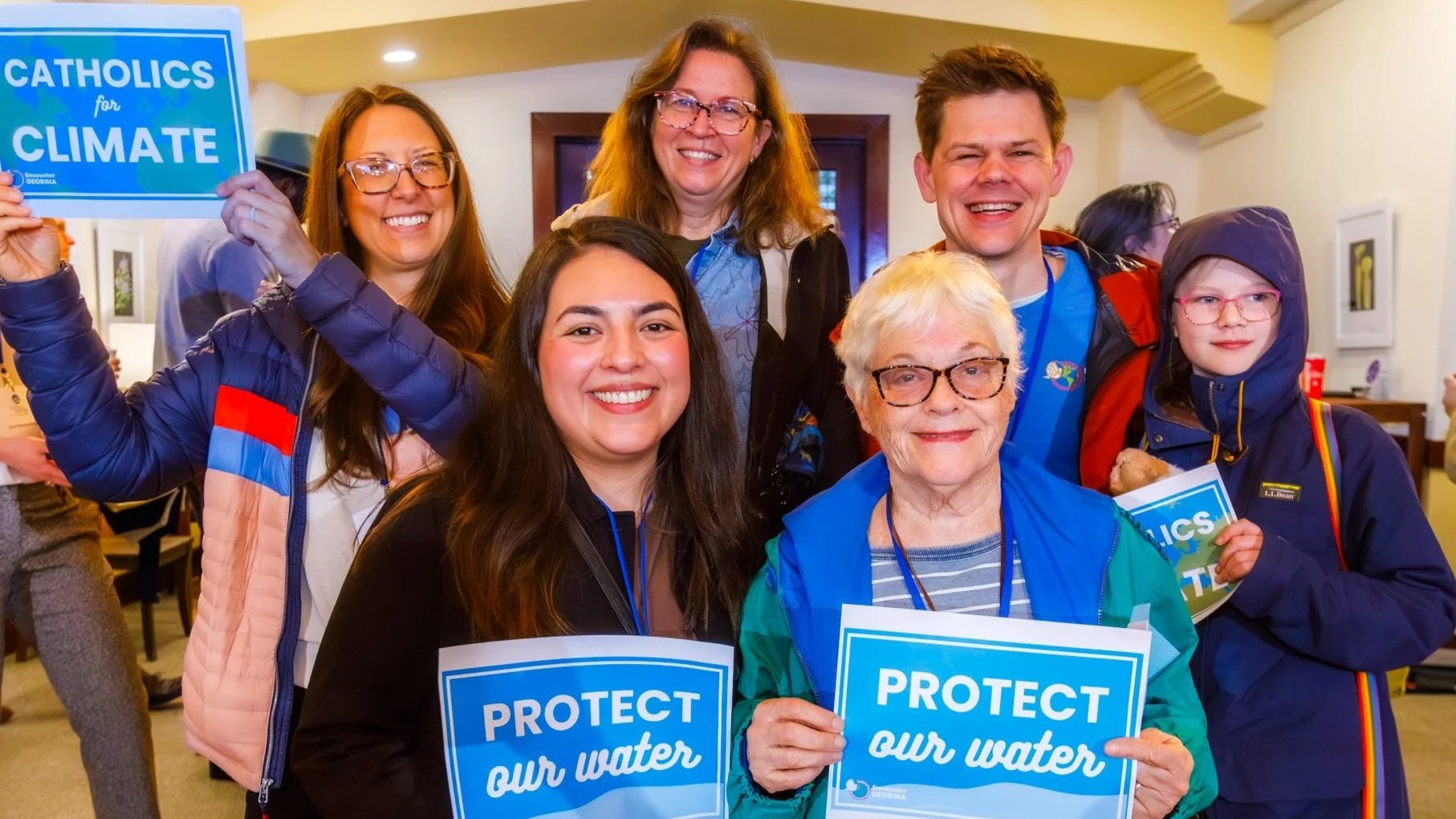
Georgia Catholics attending Capitol Conservation Day, 2026
“You might want to grab a jacket,” I told my daughter. “It’ll be cold, and there’s lots of walking.”
“I’ll grab mom’s,” she replied.
I turned around, and there she was—my eleven-year-old suddenly looking grown up, wearing an adult rain jacket and headed to her first Capitol Conservation Day.
Rain meant rain jackets of course, but it also meant for a slow, traffic-filled ride down I-85. As we listened to Politically Georgia’s discussion of “Forever Stained,” the AJC’s recent investigation into the carpet industry and impact of PFAS chemicals on Northwest Georgia, we watched as car after car carved paths like a river splashing through a canyon into the city. It was morning in Atlanta, and we all had places to go, rain or shine.
Lent comes with spring rains.
The morning commute reminded me of an annual pilgrimage my family made when I was growing up to Immaculata Catholic Church in Cincinnati, Ohio. Each year we went to “pray the steps,” climbing 96 stone steps up a grassy hillside in Mt. Adams with our backs turned to one of the best views of the Cincinnati skyline. Like good Catholics, we brought our rosaries. The memories from those years blur together now, but one detail stands out: the rain. It always seemed to be raining.
Capitol Conservation Day has become a new Lenten pilgrimage for me. Each year I attend, I try to make space for something new. This year, the “new” meant inviting people who had never attended before, which included members of my parish and faith community, and my daughter. My hope was to create moments of encounter where faithful Catholics could speak directly with their legislators about environmental concerns and climate change. This is the work of Encounter Georgia, a grassroots Catholic climate initiative dedicated to fostering conversations about environmental stewardship across our state.
At the Capitol, those encounters take a particular form. Faithful citizens “walk the ropes” seeking to meet directly with their elected officials fostering moments of listening and dialogue. They share their stories of concern over PFAS chemicals in our water, data centers placing new strain on our rivers and water supplies, and industries polluting our land, soil, and air. Legislators share the challenges of governing and balancing competing priorities. They offer insights into which bills may make it to crossover day—and sometimes they even pause for a picture.
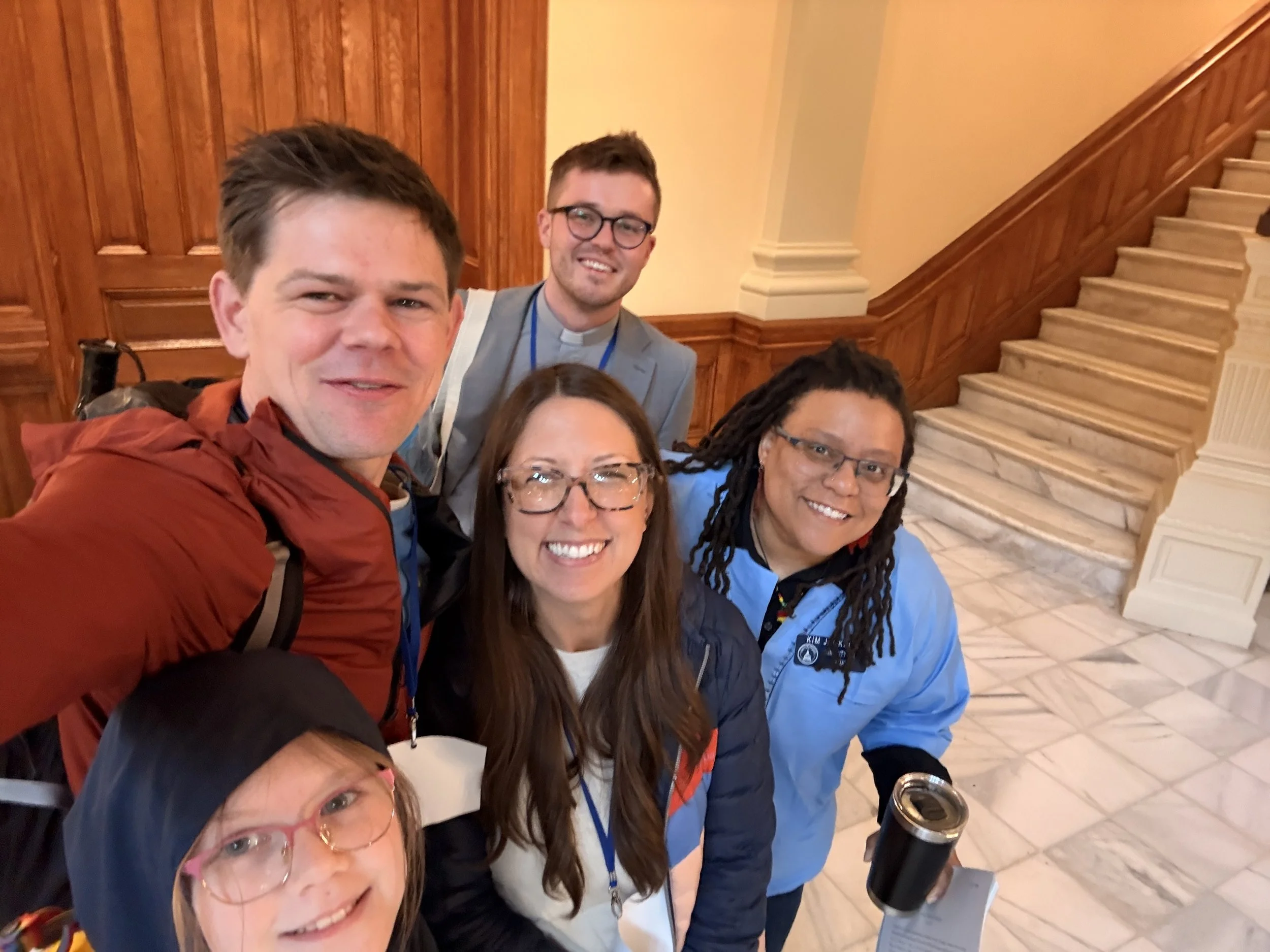
Caption: Encounter GA and GIPL’s Jay Horton meet Senator Kim Jackson
In the back of all of our minds remains the ever-present question: how much does our advocacy matter? Will our representatives truly hear, as Pope Francis describes, “both the cry of the earth, and the cry of poor?”
Maybe.
Many of the bills we advocated for will not become law—or at least, not this session. But I remain hopeful. One of my fellow parishioners wrote me afterward, “It was an incredible experience. I’ll do it again!”
Hope is not the expectation that outcomes will always go our way. Hope is the decision to act faithfully today because we know where we are going. It is the strength to move to the next rosary bead, to take the next step up the hill, and to push through the crowds at the Capitol for the chance of a brief conversation with a legislator.
Encounters like these matter because they change people. When citizens walk the halls of the Capitol, public officials are reminded that environmental decisions affect real communities and real families. At the same time, participants come to see that advocacy is not only political work, but also a form of spiritual witness.
Recently, while praying over a piece of Greenland’s ice sheets, Pope Leo XVI remarked:
“It is only by returning to the heart that a true ecological conversion can take place. We must shift from collecting data to caring; and from environmental discourse to an ecological conversion that transforms both personal and communal lifestyles. For believers, this conversion is in fact no different to the one that orients us towards the living God. We cannot love God, whom we cannot see, while despising his creatures. Nor can we call ourselves disciples of Jesus Christ without participating in his outlook on creation and his care for all that is fragile and wounded.”
Encounters at the Capitol can be a form of ecological conversion. When citizens and legislators meet face to face, something begins to change. These moments invite both to see with new eyes the beauty of the created world and our shared responsibility to care for it.
The prophet Joel expresses the same call each Lent: “Return to me with your whole heart… rend your hearts, not your garments.” Conversion begins within us, but it cannot remain there. Joel calls everyone to take part, from elders to children and families.
Pilgrimages like praying the steps in Cincinnati or walking the ropes at the Capitol work best when they lead to deeper change. When they do, they begin to form new habits of hope. Citizens show up. Conversations happen. And slowly, like rain feeding the headwaters of a river, small encounters begin to swell into a current.
As we stepped back into the rain, I gave my daughter a quick hug. She had just completed her first Capitol Conservation Day. I had a feeling it would not be her last.